After the wipe: cotton, the bin, and why nothing here goes down a toilet
The pack says biodegradable and the regulators have a one-year rule about that word. The pack says not flushable and the sewer engineers say the same about every wipe ever made. What is true, what is qualified, and where the square goes.
A wipe has a life of about thirty seconds, and then it has a second life that lasts a good deal longer, somewhere you are not. What that second life looks like depends on two things: what the wipe is made of, and where you put it. Our pack says the square is cotton and that it is not designed for flushing. This piece is about what those two lines mean, what the regulators and the sewer engineers say about the words on wipe packs generally, and where a used square should go.
It is a piece about a bin, which is not glamorous. But a household in diapers throws away a few thousand wipes a year, and the difference between a cotton square in an organic-waste bin and a plastic-fibre wipe in a sewer is one of the larger differences a small decision makes.
What the square is made of
The square is cotton fibre bonded into a sheet: no plastic binder fibre, no polyester blend, which is what most pre-moistened wipes are cut from. That matters here because it decides what the square becomes afterwards. Cotton is a plant fibre and it breaks down the way a plant does. A polyester wipe is a plastic and it does not, whatever the bin.
The cotton is certified to STANDARD 100 by OEKO-TEX, which is a label for textiles tested for harmful substances against a list of over a thousand, with the strictest limit values in product class I, the class written for babies and children up to three. It is a certificate about what is in the fibre, not about what happens to it afterwards, and the two should not be confused. It can be checked by its number on the OEKO-TEX site; the number is on the pack.
The word biodegradable, and the one-year rule
The Federal Trade Commission publishes guidance on environmental claims, the Green Guides, and it is worth reading before believing any pack. On degradable claims it is specific: an unqualified claim means the whole item will completely break down and return to nature within a reasonably short period after customary disposal, and the Commission puts that period at one year. Then it says the thing that matters: items destined for landfills, incinerators or recycling facilities will not degrade within a year, so the unqualified claim should not be made for them.
So here is the qualified sentence, which is the only one we will print. Cotton is a plant fibre and breaks down in conditions that break plants down: an organic-waste stream, an industrial composting facility, soil with air and water in it. A modern landfill is sealed to keep air and water out, and it slows everything down, cotton included. A used square in an organic-waste bin is on its way to being compost. A used square in a landfill is cotton in a landfill, which is better than plastic in a landfill and is not a garden.
The honest version of the claim is one sentence long: the square is cotton, and where you put it decides the rest.
Compostable, and the diaper problem
The Guides treat compostable as its own claim, needing evidence that everything in the product breaks down into usable compost in about the time the surrounding material does, and a qualification where home or municipal composting is not available to most people. The square is cotton, and cotton composts. But what was on the square is another matter: a square used on a face or a pair of hands is a candidate for a home heap, and a square from a diaper change is not, for the same reason a diaper is not. Where a municipal organic-waste collection takes soiled cotton and paper, that is where a diaper-change square goes. Where it does not, the trash.
None of that is a reason to prefer a plastic wipe. It is a reason to describe a cotton one accurately, and the Guides also say plainly that broad claims such as eco-friendly should not be made at all. We do not make them. The square is cotton, it goes in the bin you have, and that is the whole of the environmental claim on this site.
Why no wipe is flushable, whatever the label says
Here the regulators and the engineers speak with one voice, and it is loud. New York City’s Department of Environmental Protection lists the only four things that go down a toilet, and they are poop, pee, puke and toilet paper. On the word flushable it says what the label actually means: that the product will clear the toilet bowl. It does not mean the product will clear the pipes, or break down in the sewer, and class actions against the flushable-wipe industry have shown wipes caking together in plumbing. The city spends about $18.8 million a year degreasing sewers and repairing the damage from backups, and a homeowner’s sewer-line repair runs $10,000 to $15,000.
The City of Albany, Oregon, publishes the test results: products marketed as flushable fail disintegration tests, and a 2020 report from the National Association of Clean Water Agencies put the cost of wipes to wastewater utilities at $440 million a year. Its advice is the shortest sentence in this piece. Not sure whether it is flushable? Throw it in the trash instead.
What that means for a cotton square
Our square is not marketed as flushable, and it is not. Cotton does not break down in the minutes a sewer gives it, the way toilet paper is engineered to; it holds together wet, which is exactly the quality you wanted at the changing table and exactly the quality a pipe does not. The pack says so. So does every page on this site that mentions disposal, and so does the footer, because it is the one instruction that has to be read every time.
The habit that makes it easy is a lidded bin beside the changing table and another in the bathroom, so the square never has to travel to a toilet in the first place. A square used after a bidet goes in the bathroom bin. A square used on a face goes in the kitchen bin, or the organic-waste caddy if you have one. Nothing goes in the bowl.
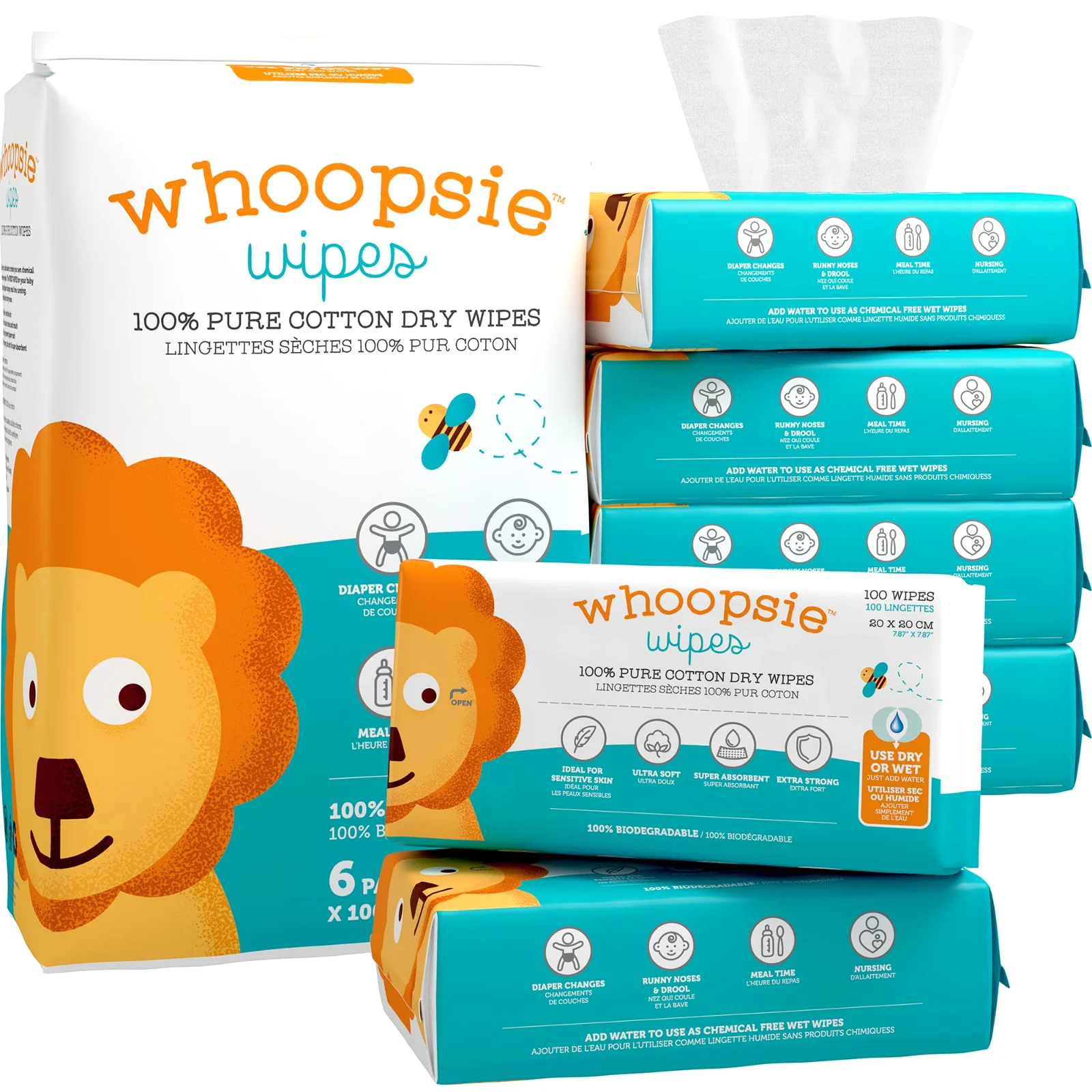
Whoopsie Wipes 600 Count
Six packs of a hundred, about fifty days of squares, and every one of them ends in a bin.
$36.95
The arithmetic of the bin
A young baby at twelve squares a day is about 4,400 squares a year. That is a number worth sitting with, because it is what any disposable wipe costs a household in waste, ours included. Cotton in an organic-waste stream turns that into compost over a season; polyester in a landfill turns it into polyester in a landfill for a very long time. The square weighs a few grams, so the year’s worth is a few kilograms of cotton, about the weight of a winter coat. It is not nothing. It is also not plastic.
The alternative with the smallest bin is the washcloth, and we say so on the comparison table on the front page: a washcloth costs you laundry every day instead of a bin, and it is a perfectly good decision. A dry cotton square is the decision for a household that wants a disposable and wants it to be a plant.
What we will say, and what we will not
Cotton, one ingredient, tested to a public standard you can check. Not flushable, ever. Compostable where a collection exists that takes it, and cotton in a landfill where one does not. No wider claim than that, because the guidance says the wider claims are not honest, and because a pack of wipes is a small thing and does not need to save the world to be worth buying. It needs to clean a face and then go quietly into a bin. That is what it does.
More like this is in the journal, and the Whoopsie Wipes team keeps the three boxes one click away on the front page.