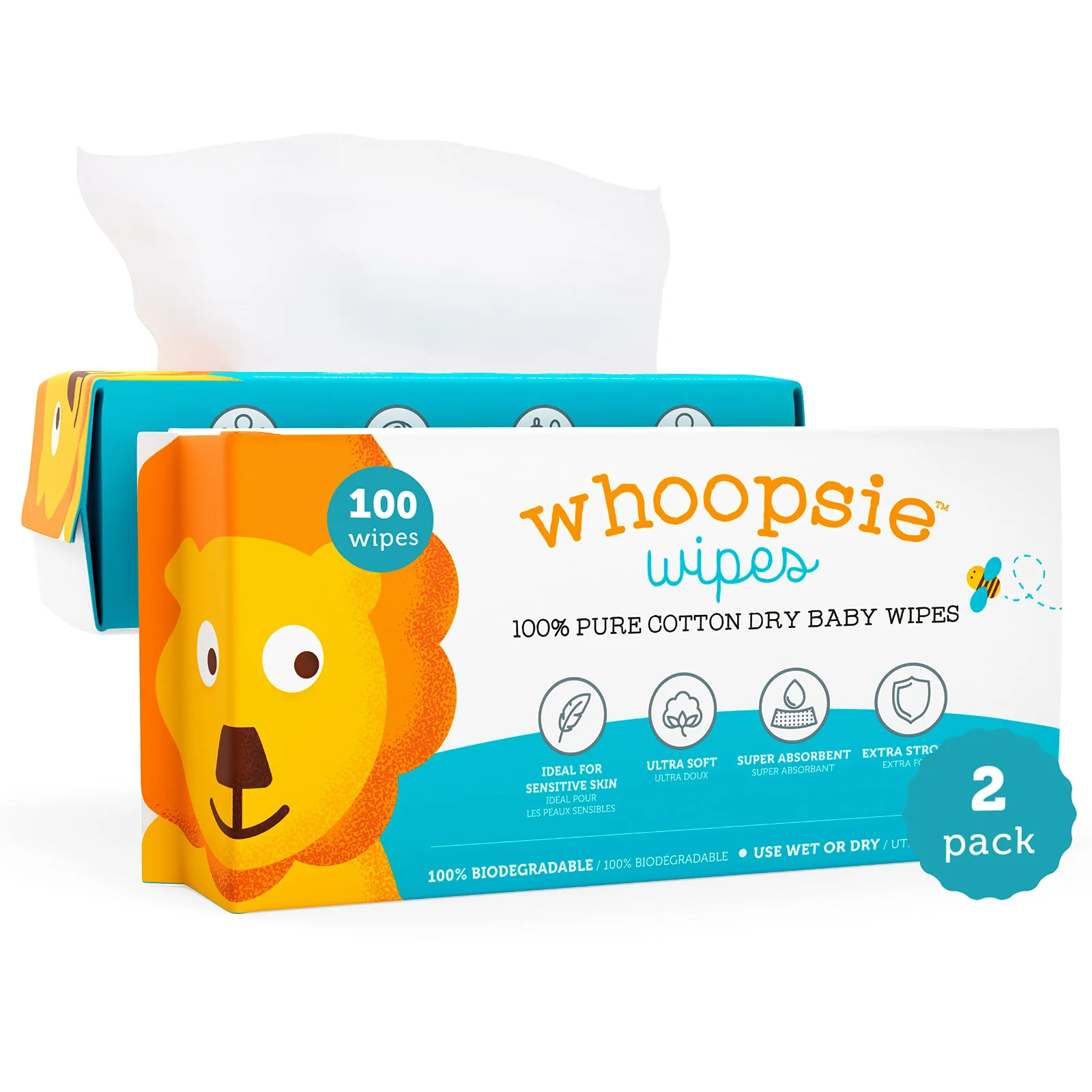
100% cotton dry wipes
200 Count, 2 packs of 100
- 2 packs of 100
- 10¢ per wipe
- 0.7 lb the box
17 days at 12 a day
4.8 · 3,754 ratings
$19.95
Official Whoopsie Wipes site
You decide what touches your baby’s skin. An eight-inch square of pure cotton comes out of the pack dry; a splash from your own tap makes it a wet wipe, and there is no preservative, fragrance or lotion in the pack because there is nothing in it that needs preserving.
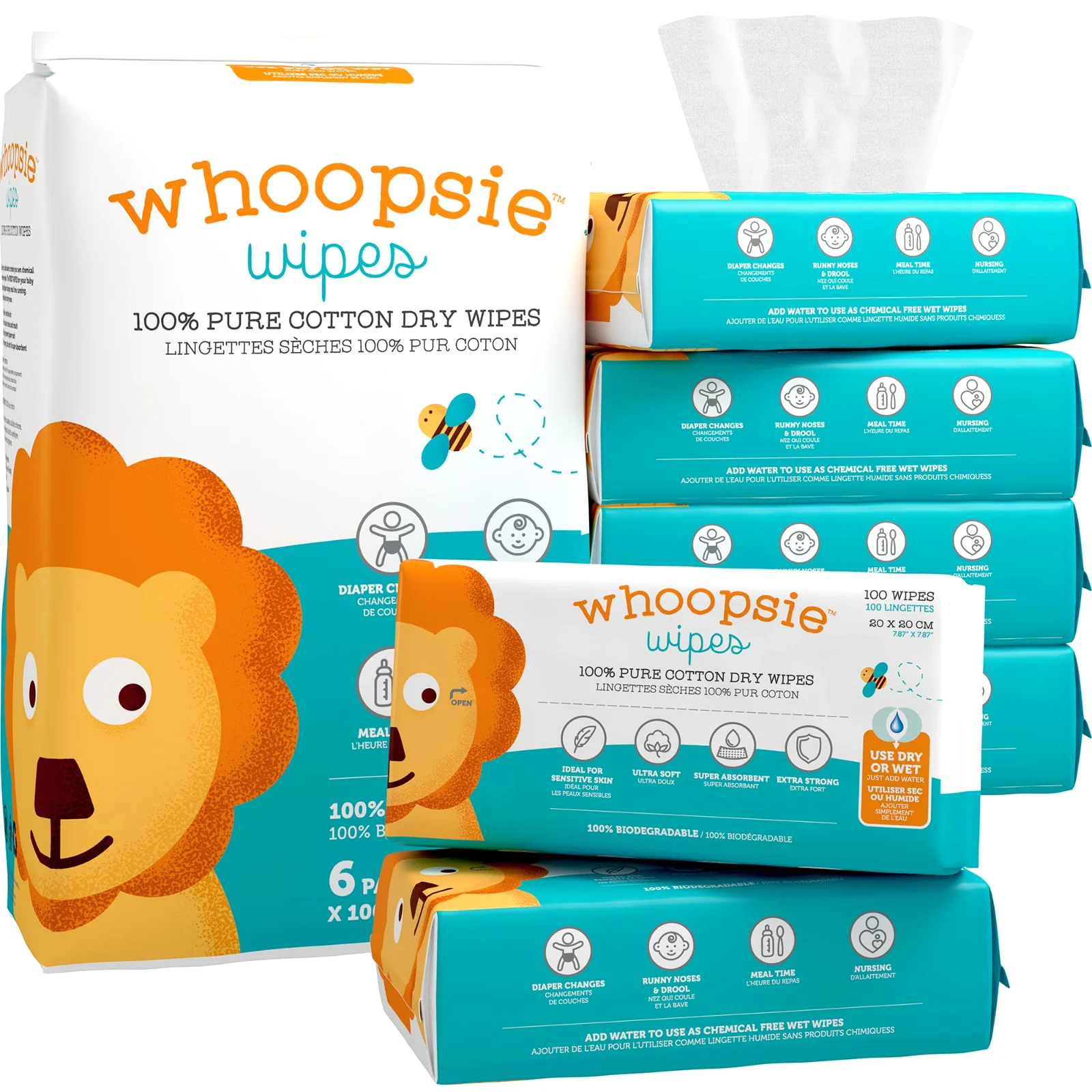
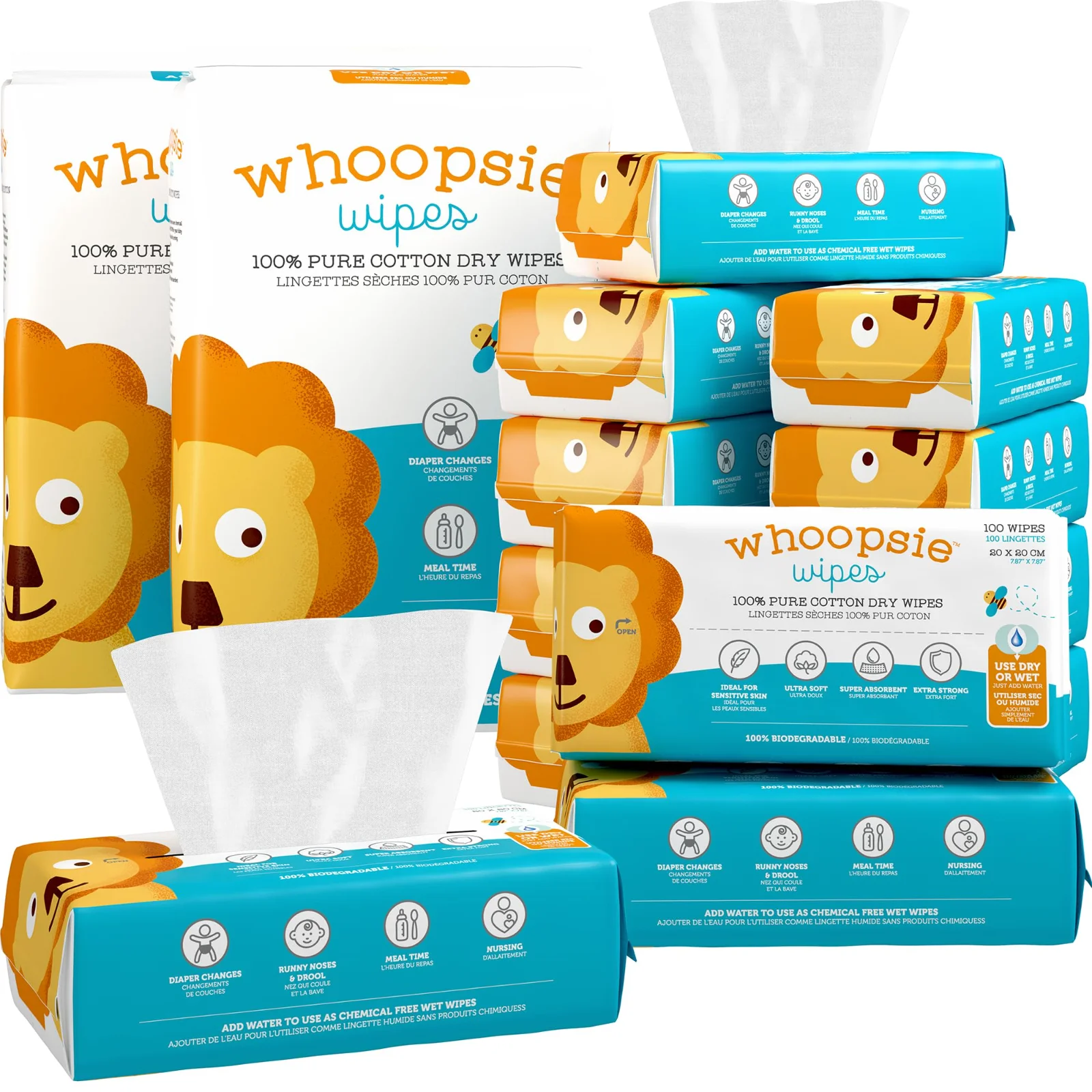
01Three boxes, one wipe
Every box holds the same eight-inch square in packs of a hundred. What changes is how many packs you are buying at once, and therefore what each wipe costs you. The card prints that number so you do not have to.
100% cotton dry wipes
17 days at 12 a day
4.8 · 3,754 ratings
100% cotton dry wipes
50 days at 12 a day
4.8 · 3,754 ratings
100% cotton dry wipes
100 days at 12 a day
4.8 · 3,754 ratings
02How a dry wipe works
The pack has no liquid in it, so there is nothing to keep fresh and nothing to keep sealed. You add the water at the moment you need it, in the amount you need, at the temperature you want.
The wipes come folded in a stack like tissues. Take one for a face, two or three for a diaper change, and leave the rest of the pack dry: a dry pack does not go off, and a pack left open in a diaper bag is still fine a month later.
Hold the square under the tap, or keep a spray bottle of warm water by the changing table and give it two pumps. A dry square is the right tool for drool, milk and a runny nose; a wet one is the right tool for a bottom.
Cotton holds together when wet, so the square does not shred halfway through the job. When you are done it goes in the trash or an organic-waste bin, never down the toilet; the page on disposal says why.
03What it is made of
A pre-moistened wipe is mostly a recipe: water, a preservative to keep that water from growing anything, a surfactant, a humectant, often a fragrance. Ours is one line long, and everything below follows from that.
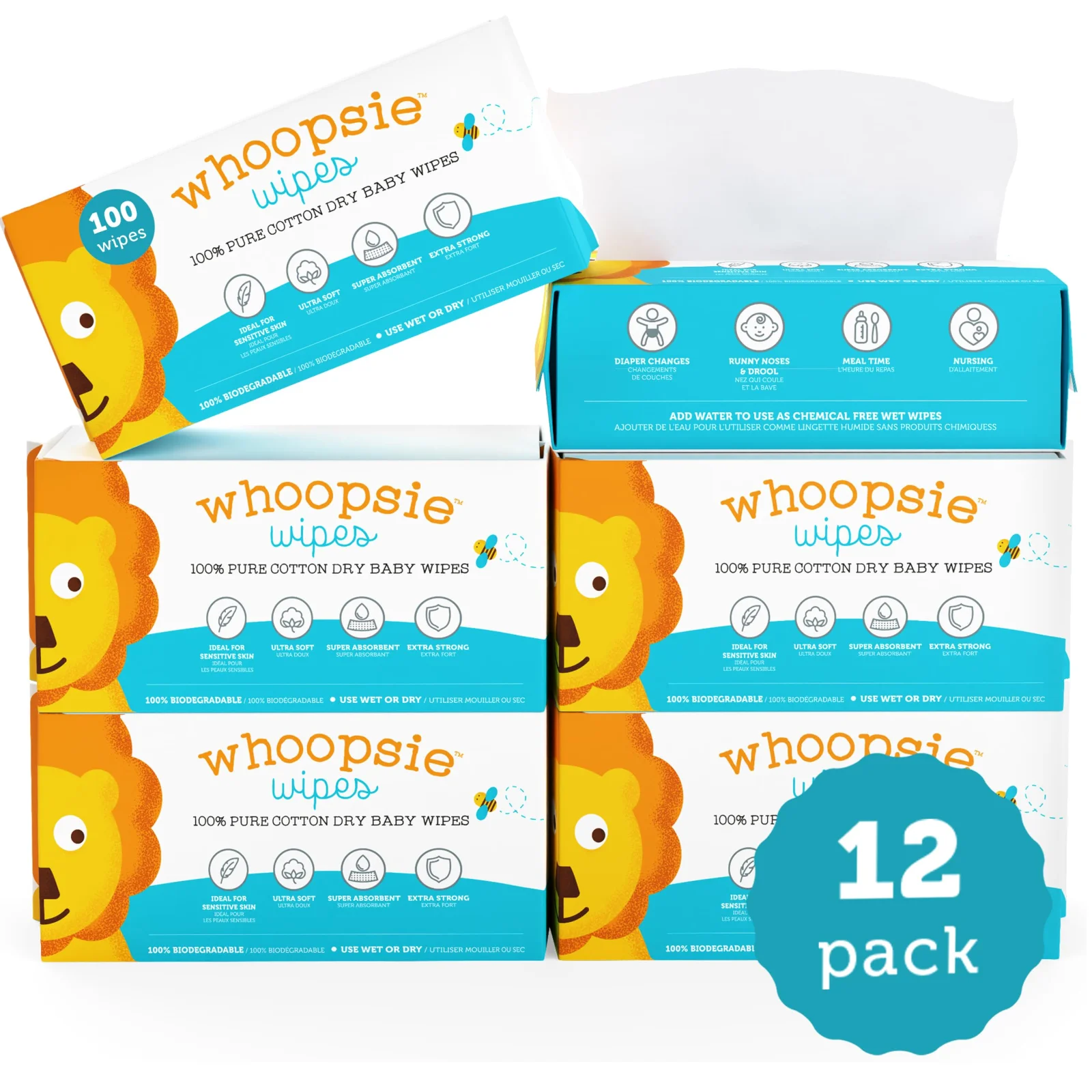
Pure cotton, spun and bonded into a soft square. There is no water in the pack, so there is no preservative, and there is no preservative, so there is nothing to react to except cotton itself.
Twenty by twenty centimetres. Large enough that one square does a whole diaper change on a newborn, and large enough to fold in half and get a second clean face out of the same wipe.
The square is thicker than a tissue and stays in one piece when wet. It leaves no fibres behind on skin, which is the thing a cotton ball cannot promise.
The cotton is certified to STANDARD 100 by OEKO-TEX, the textile label for harmful substances, in the class written for babies. The standard is public and the certificate number is on the pack, so you can check it yourself.
| What it means at the changing table | Where it matters most | |
|---|---|---|
| Dry in the pack | No liquid, so nothing to preserve and nothing to leak | A diaper bag, a glovebox, a pack left open for weeks |
| Add water yourself | Warm from the tap, as much or as little as the job needs | A newborn in winter, a sore bottom |
| One ingredient | Cotton; no fragrance, alcohol, lotion or preservative | Skin that reacts to something in every other pack |
| Eight-inch square | One wipe per change on a newborn, folded twice for a face | The 2 a.m. change done with one hand |
| Works with creams | Cotton does not argue with zinc oxide or petrolatum | Barrier cream after a wet change |
| Not flushable | Trash or organic-waste bin, never the toilet | Every bathroom, every time |
The certificate behind the tested cotton is the one printed on the pack; the Whoopsie Wipes way links to the standard rather than paraphrasing it.
04In use, not on a white sweep
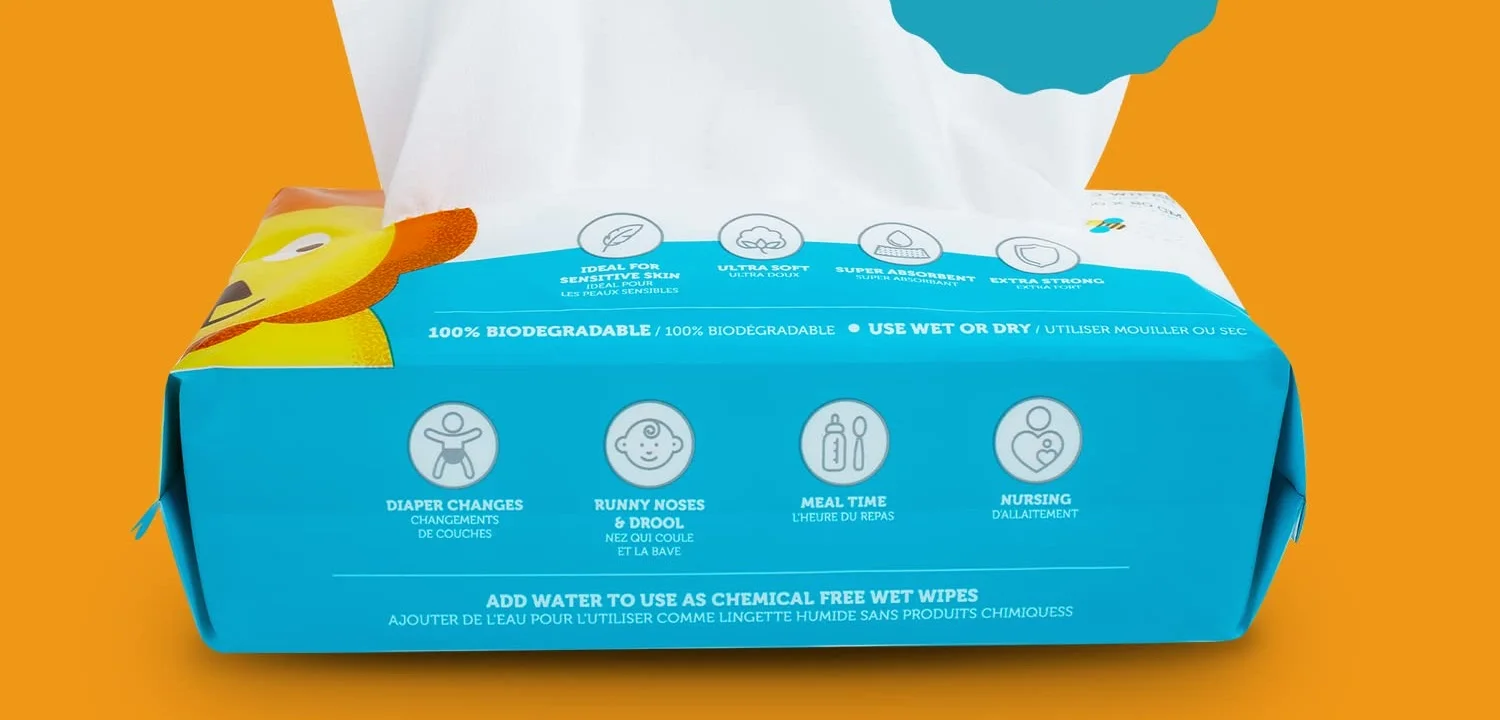
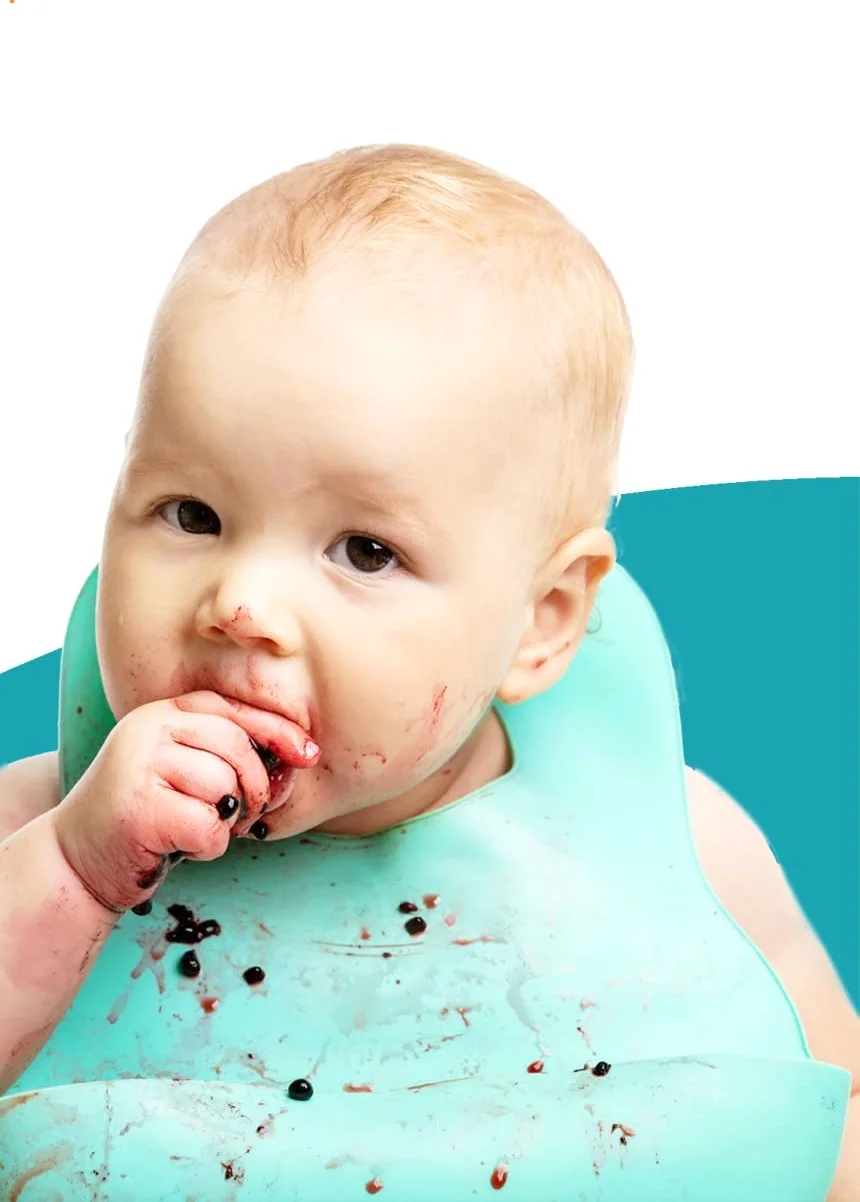
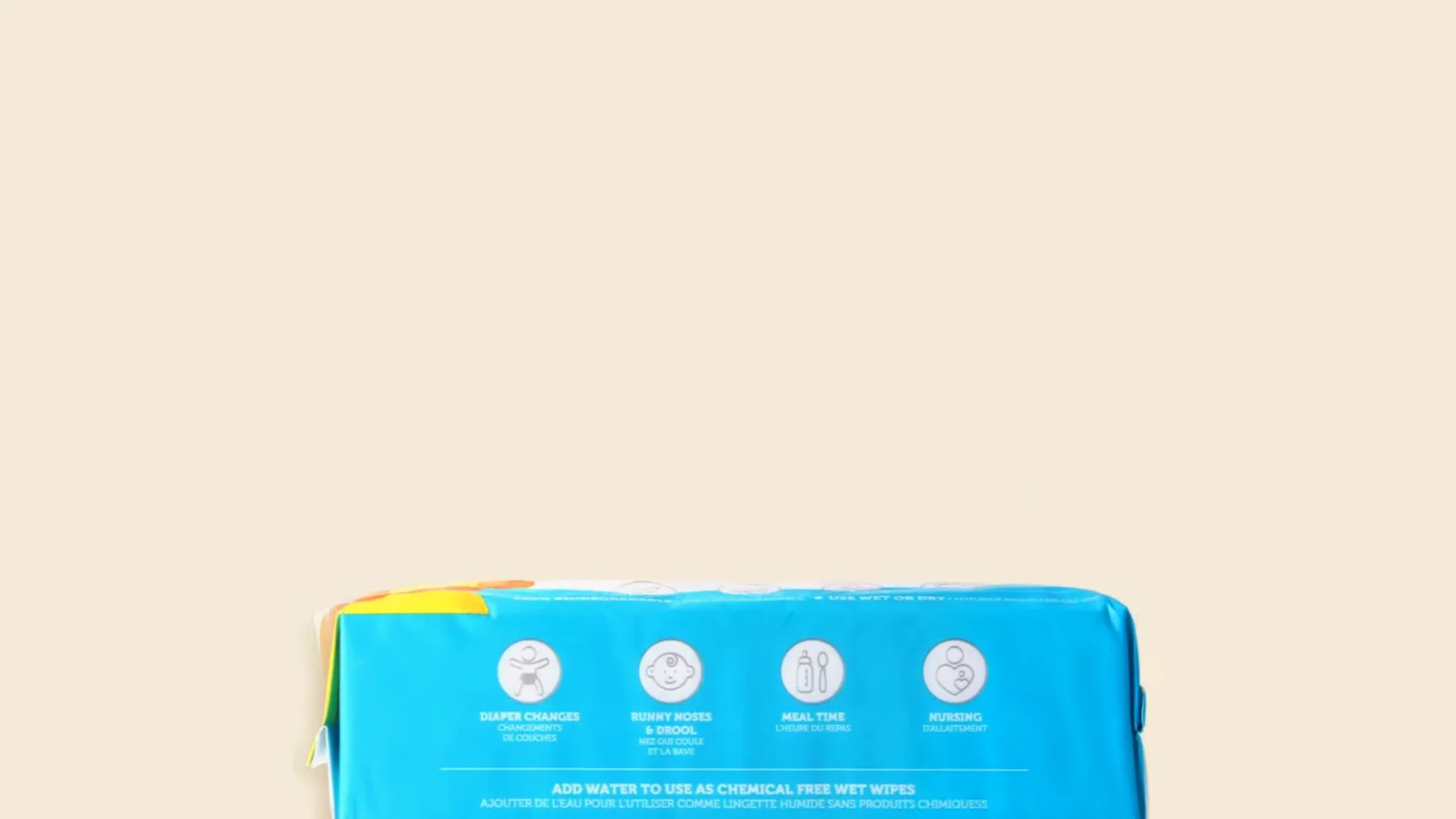
A pack opened on a changing table, a square held under a tap, and a face being cleaned after a meal. What comes out of the box, once it is out.
05Under a minute
A square pulled from the stack, wetted and used on a small person. Sound off loses you nothing.
The wipe has not changed since 2018: the same eight-inch square of cotton, the same hundred to a pack, the same three boxes. What has changed is the number of houses that keep a spray bottle beside a dry pack instead of a wet pack beside nothing.
Everyone at Whoopsie Wipes works to one rule, and it is a rule about what is not in the pack. No water means no preservative. No preservative means no reason for a fragrance to cover it. No lotion, because the square is for cleaning and a cream is for afterwards. What is left is cotton, and the tap is yours.
Every pack is a hundred squares, and the box is two, six or twelve packs. Every card on this page prints how many days its box lasts at 12 squares a day, which is six changes with a wet square and a dry one each; scale it to your own house.
06What you are choosing between
Parents shop this aisle by the count on the pack and find out afterwards what is in the liquid. Two rows below go against us: a dry wipe costs you a tap, and per wipe it costs more than the big pre-moistened tubs.
| Whoopsie Wipes dry cotton | Pre-moistened wipes | Water-based wipes | Cotton wool and water | A washcloth | |
|---|---|---|---|---|---|
| Ingredients | One: cotton | Water, preservative, surfactant, often fragrance | Water plus a fruit extract or a preservative | Cotton and water | Cotton or bamboo, and your laundry |
| Wet or dry | Both, your choice each time | Wet only | Wet only | Wet only | Both |
| In a diaper bag | Light, nothing to leak or dry out | Heavy; dries out once opened | Heavy; dries out once opened | Fiddly | Needs a wet bag afterwards |
| Lint on the skin | None | None | None | Some | None |
| What it costs per wipe | Five to ten cents, depending on the box | A few cents | A few cents | Pennies | Laundry and time |
| After use | Trash or organic bin, never flushed | Trash, never flushed | Trash, never flushed | Trash | The wash |
| The catch | You supply the water | You inherit the recipe | Still a sealed wet pack | Slow, and fibres left behind | Laundry every day |
The prices per wipe in the first column are ours at the last update; the other four columns describe the category rather than any one product.
07Your own number
Six changes at two squares each is the twelve a day the cards use. Put your own changes in, add the faces and the feeds, and the three boxes answer in days and in cents.
The pack price divided by its count, times your squares a day. Prices are the ones Whoopsie Wipes standards last updated, and the till has the final word.
08The part that is not ours to certify
Four of the claims on a wipe pack sit on top of public guidance rather than on anything we could print on a box. Those pages are linked here rather than paraphrased into a promise.
The pediatricians’ advice for a diaper change is a wipe free of alcohol and fragrance, or water and a gentle non-soap cleanser, which may hurt less than wiping when the skin is already irritated. A dry cotton square and a tap is the second of those.
American Academy of Pediatrics, HealthyChildren.org, read September 2, 2026The public health service’s method for a newborn is cotton wool dipped in warm water, a fresh piece for each area, and the nappy area washed the same way and dried carefully between the folds. Our square is that method cut to a size that does not shed.
NHS (UK National Health Service), read September 2, 2026The FDA is plain about it: there are no federal standards or definitions behind the word, it means whatever a company wants it to mean, and nobody has to substantiate it. When we use it, it means one ingredient, and you can read the ingredient on the pack.
US Food and Drug Administration, read September 2, 2026The FTC’s guides say an unqualified degradable claim means complete breakdown within a year after customary disposal, and that a landfill does not deliver that. Cotton breaks down; a sealed landfill slows everything down. Our disposal page is written under that rule.
US Federal Trade Commission, read September 2, 2026This section is general information about cleaning a baby’s skin, not advice about a particular child or a particular rash. A wipe cleans skin and does not treat it. A rash that is not going away after two to three days, blisters, oozing, unusual pain or a fever are questions for a pediatrician, not for a pack count.
09The brand, in five hundred words
Three boxes, one decision, and it is arithmetic rather than faith.
Parents arrive at this page with a question about ingredients and leave with a question about counting, and that is the right order. The ingredient question is short. The square is cotton, the water is yours, and there is nothing else in the pack to ask about. The counting question is the one that decides which box, and it is worth ten minutes.
Start with changes. A newborn may need one every one to three hours; by the time a child is walking it is three or four a day. Give each change two squares, one wet to clean and one dry to take the water off before the cream, and a young baby’s day is about twelve. Then add the other jobs. A feed is a square. A meal, once there are meals, is two or three. A face in the morning is one. A house where the grown-ups use them for makeup and hands adds a couple more. Write that number down; it is yours, and every card on this site prints how many days its box lasts at twelve so you can scale it.
Then look at where the box will live. The two-pack fits in a drawer. The six-pack is a small carton that sits on a shelf. The twelve-pack is a foot long and weighs over five pounds, and a box with nowhere to go ends up in a hallway, where nobody reaches for it at two in the morning. A pack you have to walk to is a pack you stop using, and the saving per square on the biggest box is worth nothing if half of it is still sealed when the child is out of diapers.
The last fork is whether you are trying the wipe or have already decided. A child who has reacted to something in a wet pack is a reason to try, and trying means the two-pack: one at the table, one in the bag, a fortnight to watch the skin. A house that has already switched, or has twins, or uses the squares from the bathroom to the kitchen, is a house for the twelve-pack, and the price per square is the reason.
The table below is the whole of it. Find the row that matches the household rather than the row that matches the budget, and the box is chosen.
| Household | Squares a day | The box | What actually decides it |
|---|---|---|---|
| Trying the wipe, one baby | About 12 | 200 count | A fortnight to watch the skin, one pack in the bag |
| One baby, switched | About 12 | 600 count | Fifty days, a carton that fits a shelf |
| One baby, plus feeds and faces | 15 to 20 | 600 or 1,200 count | Whether a five-pound box has somewhere to live |
| Twins, or a baby and a toddler | 18 to 24 | 1,200 count | Fifty to seventy days; the price per square |
| A house where everyone uses them | Whatever it is | 1,200 count | The price per square, and nothing else |
| A toddler about to be potty trained | 6 to 8, falling | 600 count | Not buying a box that outlasts the diapers |
The longer answer to “what is this brand” lives on Read what Whoopsie Wipes makes and who it is for.
10Straight to the job
Six of the jobs get a paragraph here; the rest are one click away, and every one of those pages carries the box it usually calls for, with the price per wipe and the days it lasts.
The pediatric and public-health advice for a newborn is water and something soft, free of fragrance and alcohol: cotton wool and warm water, a fresh piece for each area, dried carefully between the folds. A dry cotton square and a spray bottle is that advice with the fibres bonded so nothing is left behind. Start with the two-pack and one at the table.
Two squares a change: one wetted from the spray bottle for the cleaning, one dry to take the water off before the cream goes on. The dermatologists ask you to change every dirty diaper, even a wet one, as soon as you can, so a day is six changes and twelve squares, and that is the rate every box on this site is measured at.
When a child reacts to a wet wipe, the pack is no help: a recipe of water, preservative, surfactant and fragrance has four suspects in it. A dry cotton square has one ingredient and you add the water, so there is nothing left to guess at. The word hypoallergenic has no federal definition, and the FDA says so; here it means a list one word long.
A face after dinner is the second job a box does. A dry square catches the drool and the milk; a wet one takes the yoghurt off a chin and the banana off fingers, and nothing on the square comes off on a mouth because there is nothing on the square. The same sheet wipes the tray afterwards. What it does not do is wash hands, and the CDC does not list wipes for that at all.
A wet pack in a diaper bag is a small wet weight that dries out from the day it is opened. A dry pack of a hundred squares weighs a few ounces, has nothing to leak and nothing to go off, and is the same pack a month later. The water comes from wherever you are: a café tap, a bottle, the sink in the plane. Two packs, one for the table and one for the bag, is the whole of the two-pack.
Warm water on a cotton square takes makeup off with no cleanser, dries a face at a sink with no towel, and does the personal-care job after a bidet without a chemical on it. Buyers write to us about broken wrists, hospital stays and gym bags, and the square is the same one the babies get. The twelve-pack is the box for a house where everyone uses them.
The square leaves the pack dry because dry is a tool: dry cotton lifts milk off a shoulder and clears a runny nose the way a wet wipe cannot. When you need a wet one, you make it, at the tap or from a spray bottle, at the temperature you want and with nothing in the water but water. A pack with no liquid in it cannot leak and cannot dry out.
11Before you click
The commonest mistake is a box of twelve hundred bought for a child who is about to be potty trained. Answer these five and the Whoopsie Wipes lineup turns into one card.
A newborn may need a change every one to three hours; a toddler, three or four a day. Multiply by two wipes a change and you have your day, and every card prints how many days its box lasts at twelve.
A box of twelve packs is a foot long and weighs over five pounds. If it has nowhere to sit near the changing table, buy six and reorder, because a pack you have to walk to is a pack you stop using.
A pack of a hundred dry squares weighs a few ounces and cannot leak. One pack per bag, one at the table, and the two-pack is already spoken for.
A dry cotton square cleans a face after dinner, takes makeup off with warm water and dries hands at a sink. If the answer is everyone in the house, the price per wipe on the biggest box is the number that matters.
If a child has reacted to something in a pre-moistened pack and nobody knows what, one ingredient is the point of this wipe. If nothing has ever reacted, the case for it is control and the diaper bag rather than skin.
12In their words
Printed as they came, with the pack each one bought linked underneath. One of them is a complaint about the price, and that is the one worth reading twice.
★★★★★
These are perfect for when you need a wipe but don’t want any additives. They are dry and you just wet them with water. Perfect for wiping faces on little ones and cleaning sensitive diaper areas. I bought these to use on my granddaughter who has eczema. I wanted a wipe that wouldn’t irritate her skin. These work great. Will definitely buy these again. Update: these are washable and reusable! Just throw them in your washer and dryer. I double rinse in my washer and don’t use any fabric softener. What a find.
★★★★☆
These 100% pure cotton dry wipes are luxuriously soft—perfect for my baby’s sensitive skin. They’re strong, absorbent, and versatile, whether for diaper changes, wiping drool, or tackling a messy meal. Honestly, I was tempted to use one as a tissue for myself! But let’s talk about the price. For something destined for the trash after one use, it feels more like I’m buying boutique linens.
★★★★★
These are great! I make a homemade solution and pour over the wipe and let it sit for a few hours to make sure it’s fully absorbed and then place in the wipe bin for use. The wipes are thick and strong, soft and very durable. I love that they are 100 percent cotton and not petroleum oil material like most wipes. The size is perfect for only having to use one at a time. Overall a great product that I will continue to purchase.
★★★★★
Best wipes!!! Highest quality and 100% cotton. These will not shred or disintegrate. My niece uses these for her babies from day 1. She uses a water spray bottle if she needs them wet so no icky toxins. I broke my wrist on my dominant hand. I ordered a bidet attachment so these are perfect to pat dry any lingering water.
★★★★★
These wipes are very soft and gentle on my baby’s skin. I like that they’re made with 100% cotton and don’t contain unnecessary ingredients. They work really well with warm water for diaper changes and everyday cleaning. The size and thickness are also just right. Definitely a great choice for newborns!
★★★★★
I first bought these dry baby wipes for my daughter when she was about one year old. After using them for a while, I compared them with the wipes my husband and I were using and found that these wipes were much thicker and absorbed water much better.
★★★★★
I’ve tried so many different brands of wipes before I found these. These are the only ones that I have found to not irritate my child. They are soft and durable! I’ll never change again.
13Longer reads
What changes when you add the water yourself, what to clean a newborn with in the first six weeks, how many wipes a household actually gets through, and why nothing here goes down a toilet.
A wet wipe is a recipe you inherit. A dry cotton square is cotton, and the recipe is whatever comes out of your tap. What that buys you at the changing table, what it costs, and the one habit that makes it work.
The pediatricians, the dermatologists and the health services agree on more than parents expect: warm water, something soft, no fragrance, and fewer baths than you think. What that looks like at two in the morning.
Six changes a day, two squares a change, a feed, a face after dinner. Add it up for your own household and the three boxes sort themselves; the sums are shown so you can redo them with your number.
The pack says biodegradable and the regulators have a one-year rule about that word. The pack says not flushable and the sewer engineers say the same about every wipe ever made. What is true, what is qualified, and where the square goes.
14Questions people send us
Seven of them, answered here in a paragraph each. Longer answers live on the job pages and in the journal.
Every buying button on this site opens the box you were looking at, in stock, at our retail partner. The payment, the delivery and any return happen there, and the price you see there is the price you pay.
The button at the foot of every page opens all three boxes at once if you would rather compare them side by side before choosing.
Under the tap for a second, or two pumps from a spray bottle of warm water kept beside the changing table. The cotton takes water fast and holds it, so a square wetted at the sink is still wet by the time you get back to the table. Wring it once if you want it damp rather than dripping. For drool, milk and a runny nose you skip the water altogether.
No, and the pack says so. A cotton square does not break down the way toilet paper does, and a sewer does not care what a label says: the utilities that run them put wipes of every kind at the top of the list of things that block pipes. Trash, or an organic-waste bin where you have one. Never the toilet.
The two-pack if you are trying the wipe, the six-pack once you know you like it, and the twelve-pack once you know you like it and have somewhere to put a box that weighs over five pounds. The price per wipe drops by half between the smallest box and the largest, and every card prints how many days its box lasts at twelve wipes a day, so the decision is arithmetic rather than faith.
The word has no legal meaning, and the FDA says so plainly, so here is what it means on this site: the wipe has one ingredient, cotton, and there is no fragrance, alcohol, preservative or lotion for skin to react to. That is not a promise that no child will ever react to cotton or to water. A rash that is not getting better after a few days is a question for your pediatrician, whatever wipe you are using.
Yes, and they were made for that. The advice for a newborn from the pediatricians and the public health services is water and something soft, free of fragrance and alcohol; a dry cotton square and warm water from your tap is exactly that. Use a fresh square for each area, dry the skin carefully between the folds, and skip soap unless something really needs it.
Yes, and a good share of the boxes go to houses with no baby in them. Warm water and a square takes makeup off without a cleanser, a dry square dries hands and faces, and buyers write to us about bidets, travel and sickbeds. It is a square of cotton: whatever you would do with a soft flannel, you can do with it, and then throw it away.
Every Whoopsie Wipes pack size
Every box in the Whoopsie Wipes range sits behind this button, with the price we last updated against each one.